
![1 meter Black Cable Wire Carrier Drag Chain Nested 25mm x 38mm CNC Automation [78301]](http://www.odroid.co.uk/cdn/shop/files/00_e10b65f5-a97a-432b-823d-cd461fd0d3df.jpg?v=1791827975&width=120)
![10GbE M.2 Card [134000]](http://www.odroid.co.uk/cdn/shop/files/01.jpg?v=1791812554&width=120)
![Odroid Operating System - 128GB eMMC 5.0 Module [88882]](http://www.odroid.co.uk/cdn/shop/files/01_f4577646-f108-4931-94e3-fcf9d64ed2c7.jpg?v=1791813807&width=120)
Hardkernel Odroid C4 - 2GB 64-bit quad-core Single Board Computer [77700]
Hardkernel Odroid C4 - 2GB 64-bit quad-core Single Board Computer [77700]
![Odroid C4 - 2GB 64-bit quad-core Single Board Computer [77700]](http://www.odroid.co.uk/cdn/shop/files/01_8612d764-1b89-40d6-b529-3f6902a63517.jpg?v=1791827151&width=1946)
![Odroid C4 - 2GB 64-bit quad-core Single Board Computer [77700]](http://www.odroid.co.uk/cdn/shop/files/02_aef44f99-e2e0-42d4-b1a8-992ccf963755.jpg?v=1791827151&width=1946)
![Odroid C4 - 2GB 64-bit quad-core Single Board Computer [77700]](http://www.odroid.co.uk/cdn/shop/files/03_8ce7d0e7-5b99-4903-81dd-278bac0c0549.jpg?v=1791827151&width=1946)
![Odroid C4 - 2GB 64-bit quad-core Single Board Computer [77700]](http://www.odroid.co.uk/cdn/shop/files/04_3d022b8b-3ece-4e9a-b89a-47932dfca190.jpg?v=1791827151&width=1946)
![Odroid C4 - 2GB 64-bit quad-core Single Board Computer [77700]](http://www.odroid.co.uk/cdn/shop/files/05_19e2c22c-f557-4494-bb4b-9554bfe59654.jpg?v=1791827151&width=1946)
![Odroid C4 - 2GB 64-bit quad-core Single Board Computer [77700]](http://www.odroid.co.uk/cdn/shop/files/06.jpg?v=1791827151&width=1946)
![Odroid C4 - 2GB 64-bit quad-core Single Board Computer [77700]](http://www.odroid.co.uk/cdn/shop/files/07.jpg?v=1791827151&width=1946)
![Odroid C4 - 2GB 64-bit quad-core Single Board Computer [77700]](http://www.odroid.co.uk/cdn/shop/files/08_c880fe04-a542-485c-9802-629b1a62d07a.png?v=1791827151&width=1946)
![Odroid C4 - 2GB 64-bit quad-core Single Board Computer [77700]](http://www.odroid.co.uk/cdn/shop/files/01_8612d764-1b89-40d6-b529-3f6902a63517.jpg?v=1791827151&width=1445)
![Odroid C4 - 2GB 64-bit quad-core Single Board Computer [77700]](http://www.odroid.co.uk/cdn/shop/files/02_aef44f99-e2e0-42d4-b1a8-992ccf963755.jpg?v=1791827151&width=1445)
![Odroid C4 - 2GB 64-bit quad-core Single Board Computer [77700]](http://www.odroid.co.uk/cdn/shop/files/03_8ce7d0e7-5b99-4903-81dd-278bac0c0549.jpg?v=1791827151&width=1445)
![Odroid C4 - 2GB 64-bit quad-core Single Board Computer [77700]](http://www.odroid.co.uk/cdn/shop/files/04_3d022b8b-3ece-4e9a-b89a-47932dfca190.jpg?v=1791827151&width=1445)
![Odroid C4 - 2GB 64-bit quad-core Single Board Computer [77700]](http://www.odroid.co.uk/cdn/shop/files/05_19e2c22c-f557-4494-bb4b-9554bfe59654.jpg?v=1791827151&width=1445)
![Odroid C4 - 2GB 64-bit quad-core Single Board Computer [77700]](http://www.odroid.co.uk/cdn/shop/files/06.jpg?v=1791827151&width=1445)
![Odroid C4 - 2GB 64-bit quad-core Single Board Computer [77700]](http://www.odroid.co.uk/cdn/shop/files/07.jpg?v=1791827151&width=1445)
![Odroid C4 - 2GB 64-bit quad-core Single Board Computer [77700]](http://www.odroid.co.uk/cdn/shop/files/08_c880fe04-a542-485c-9802-629b1a62d07a.png?v=1791827151&width=1445)
ODROID-C4:
ODROID-C4 is a new-generation single-board computer that is more energy-efficient and faster performing than ODROID-C2, which was introduced over four years ago as the world’s first affordable ARM 64-bit computer.
The main CPU of the ODROID-C4 is built with a quad-core Cortex-A55 cluster with a new-generation Mali-G31 GPU. The A55 cores run at 2.0Ghz without thermal throttling using the stock heat sink, allowing a robust and quiet computer. The CPU multi-core performance is around 40% faster, and the system DRAM performance is 50% faster than the ODROID-C2.
Technical information at WiKi: https://wiki.odroid.com/odroid-c4/odroid-c4
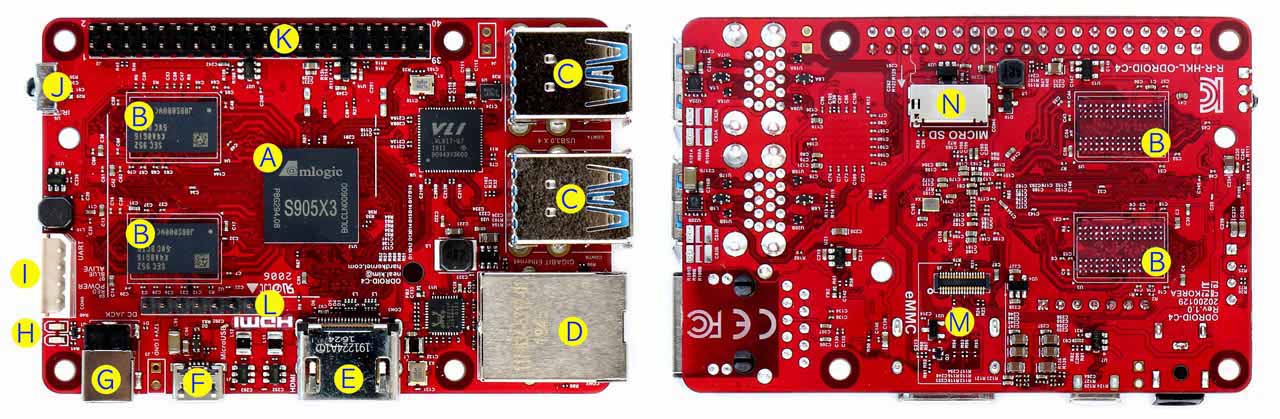
| A | CPU (Amlogic S905X3) | H | 2 x System LED indicators |
| B | DDR4 memory (2GiB) | I | 1 x UART for system console |
| C | 4 x USB 3.0 host ports | J | 1 x IR receiver |
| D | 1 x RJ45 Ethernet port (10/100/1000) | K | 40 x GPIO pins |
| E | 1 x HDMI 2.0 | L | 7 x GPIO pins |
| F | 1 x Micro USB 2.0 port (OTG) | M | 1 x eMMC module socket |
| G | 1 x DC power jack (Outer diameter: 5.5mm, inner diameter: 2.1mm) | N | 1 x Micro SD slot |
CPU performance
Dhrystone-2, Double-Precision Whetstone, 7-zip compression benchmark results show the ODROID-C4 system performance is 40 ~ 55% faster than the previous generation ODROID-C2.
GPU performance
The Mali-G31 runs at 650MHz and is ~50% faster than Mali-450MP in ODROID-C2. The Mali-G31 is the first generation Bifrost-based mainstream GPU from Arm. GPU performance was measured with the glmark2-es2 “–off-screen” option.
RAM performance
Why does DDR4 matter? ODROID-C4 DDR4 RAM runs at 1320Mhz. The memory bandwidth is 1.6 times higher than ODROID-C2.
CPU frequency vs performance
Some ODROID users may recall the lower-than-expected clock speed with ODROID-C2’s S905. We ran a test to confirm the ratio between CPU clock frequency and performance with ODROID-C4.
Thermal characteristics
To check thermal throttling, we ran some heavy CPU and GPU loads together on the SoC and monitored the temperature. We ran the test within a chamber that maintains the ambient temperature at 25°C.
Note that the current thermal throttling point is set at 75°C in the Kernel configuration.
Note that if you put the ODROID-C4 board into an enclosure, you may encounter some thermal throttling issues when the ambient temperature is higher than 20°C and the continuous computing load is very high.
Ethernet
According to our iperf test results, the throughput performance was near 1Gbps.
USB Host
We measured the USB3 transfer speed with a UAS-capable SSD. The average ~340MB/s of throughput should be acceptable for many applications. Since four USB host ports share a single root hub, the transfer rate will be lower if you use multiple USB3 devices at the same time.
Cryptography
The ARMv8 architecture supports hardware-accelerated crypto extensions for building a secure system. As expected, we could see very decent OpenSSL performance with ODROID-C4.
GPIO (40Pin Header)
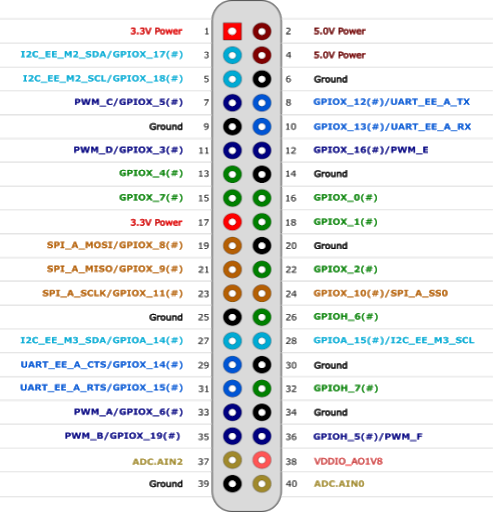
The ODROID-C4 GPIO interface is similar to C2 and fully supports a 3.3Volt interface. This is beneficial for using various peripherals without complicated level shifters, as with the XU4’s 1.8Volt GPIOs. Another big improvement is a faster SPI bus interface with a maximum frequency of about 100Mhz. It is significantly faster than the ODROID-C2’s 400Khz software “bit-banged” SPI.
Power consumption
Thanks to the modern 12nm fabricated S905X3 CPU, the power consumption and heat dissipation are relatively very low. Therefore, we can enjoy a quiet and powerful computer with high energy efficiency.
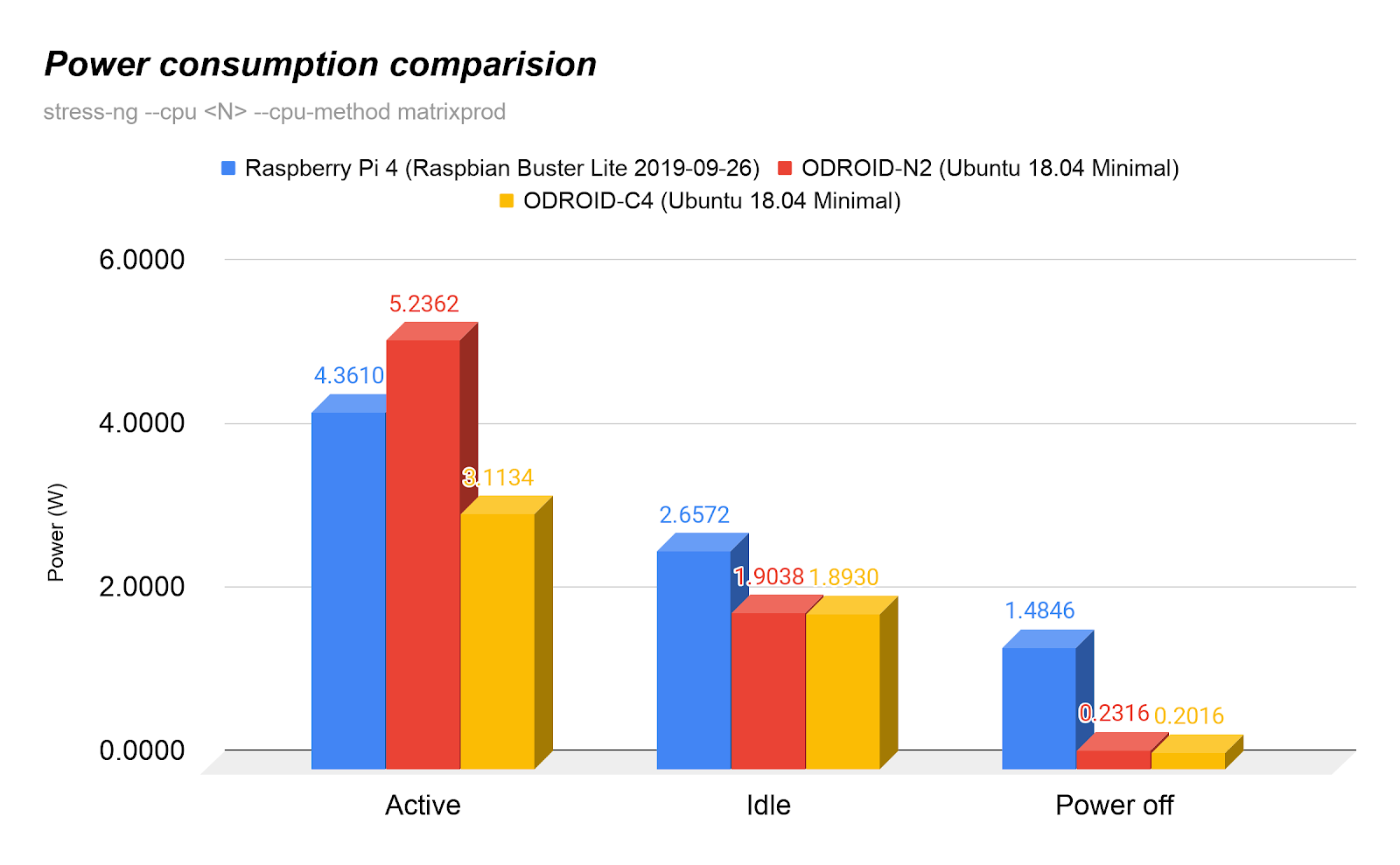
Idle state: ≃ 0.18 Watt
Heavy load state: 3.1~3.3 Watt (stress-ng –cpu 4 –cpu-method matrixprod)
No cables are attached except the DC power input and USB-UART debug console cable.
Note:
- The power consumption in “IDLE” is measured when a device is not being operated for 5 minutes since the CPU governor is set to ‘performance’.
- The measured power consumption is not absolute and could vary in certain conditions.
Specifications
| Form factor | Board Dimensions: 85mm x 56mm x 1.0mm Heatsink Dimensions: 40mm x 32mm x 10mm Weight: 59g including heatsink |
| Processor | Amlogic S905X3 12nm Processor L1 instruction cache: 32 KB, 4-way set associative (128 sets), 64-byte lines, shared by 1 processor L1 data cache: 32 KB, 4-way set associative (128 sets), 64-byte lines, shared by 1 processor L3 data cache: 512KB, 16-way set associative (512 sets), 64-byte lines, shared by 4 processors Quad-Core Cortex-A55 (2.016GHz) ARMv8-A architecture with Neon and Crypto extensions Mali-G31 MP2 GPU with 4 x Execution Engines (650Mhz) |
| Memory | DDR4 2GiB with 32-bit bus width Data rate: 2640 MT/s (PC4-21333 grade) 1.2Volt low power design |
| Storage | 1x eMMC connector (8/16/32/64GiB are available) 1x Micro SD slot (DS/HS mode up to UHS-I SDR104) |
| Networking | 1 x GbE LAN port (RJ45, supports 10/100/1000 Mbps) – Realtek RTL8211F (Ethernet transceiver) – LED indicators * Green LED: Flashing due to data traffic at 100Mbps connection * Amber LED: Flashing due to data traffic at 1000Mbps connection Optional WiFi USB adapters |
| Video | 1 x HDMI 2.0 (up to 4K@60Hz with HDR, CEC, EDID) |
| Audio | 1 x HDMI digital output 1 x Optional SPDIF optical output |
| External I/O | 4 x USB 3.0 Host ports (shares one single root hub) 1 x USB 2.0 OTG port for Host or Device mode. (No power input) 1 x Debug serial console (UART) 1 x Peripheral Expansion Header (40-pin, 2.54mm pitch)
1x Audio Expansion Header (7-pin, 2.54mm pitch)
– All 3.3V I/O signal levels except for ADC input at max 1.8Volt. |
| Other features | IR receiver for remote controller System LED Indicators: – Red (PWR) – Solid light when DC power is connected – Blue (ALIVE) – Flashing like heartbeat while Kernel is running. |
| Power | 1 x DC jack: outer (negative) diameter 5.5mm, inner (positive) diameter 2.1mm DC input : 5.5V ~ 13V (*15V/4A PSU is not compatible with C4) – DC 12V/2A power adaptor is recommended Power consumption: – IDLE: ≃ 1.8W – CPU Stress: ≃ 3.64W (Performance governor) – Power-off: ≃ 0.14W |
Compatibility
| Compatible boards | ODROID-C4, ODROID-C2, ODROID-XU4 |
|---|